AI tools are now part of how many yearbooks get made. Some schools use them well, and some have ended up apologizing. Here's a quick four-question check, plus a free policy, to help your team decide where AI fits in your book.
The short answer: yes, with limits. AI is a great fit for organizing pages, tagging photos, removing backgrounds and creating theme art that doesn't show real people. It isn't a fit for creating or changing a real student's likeness without permission, or for showing something that never happened. If an AI image could pass for a real photo, label it. And put your rules in writing, so everyone on staff works from the same page.
Why AI in yearbooks is a conversation right now
This year has brought plenty of headlines about AI in school yearbooks. Some are success stories. Others describe students opening their new book and not recognizing their own faces.
We see both sides in the books our schools create at Picaboo Yearbooks.
"We've seen an explosion of AI imagery in yearbooks," said Elias Jo, CEO of Picaboo Yearbooks. "Some schools are using it a lot, and some are using it a little. The schools that get into trouble usually have a creative, aggressive technology stance and aren't afraid to be pioneers, which is a good thing. But they push it so far that the book loses some of the authenticity of who was actually graduating that year. That's the danger of overusing AI in a yearbook."
The lesson for advisers: set your boundaries before pages go to proof, not after the books are handed out. The check below makes that easy.
The 4-question check for AI in your yearbook
Run every image in your book through these four questions, whether AI touched it or not: Real, Permission, Truthful, Disclosed.
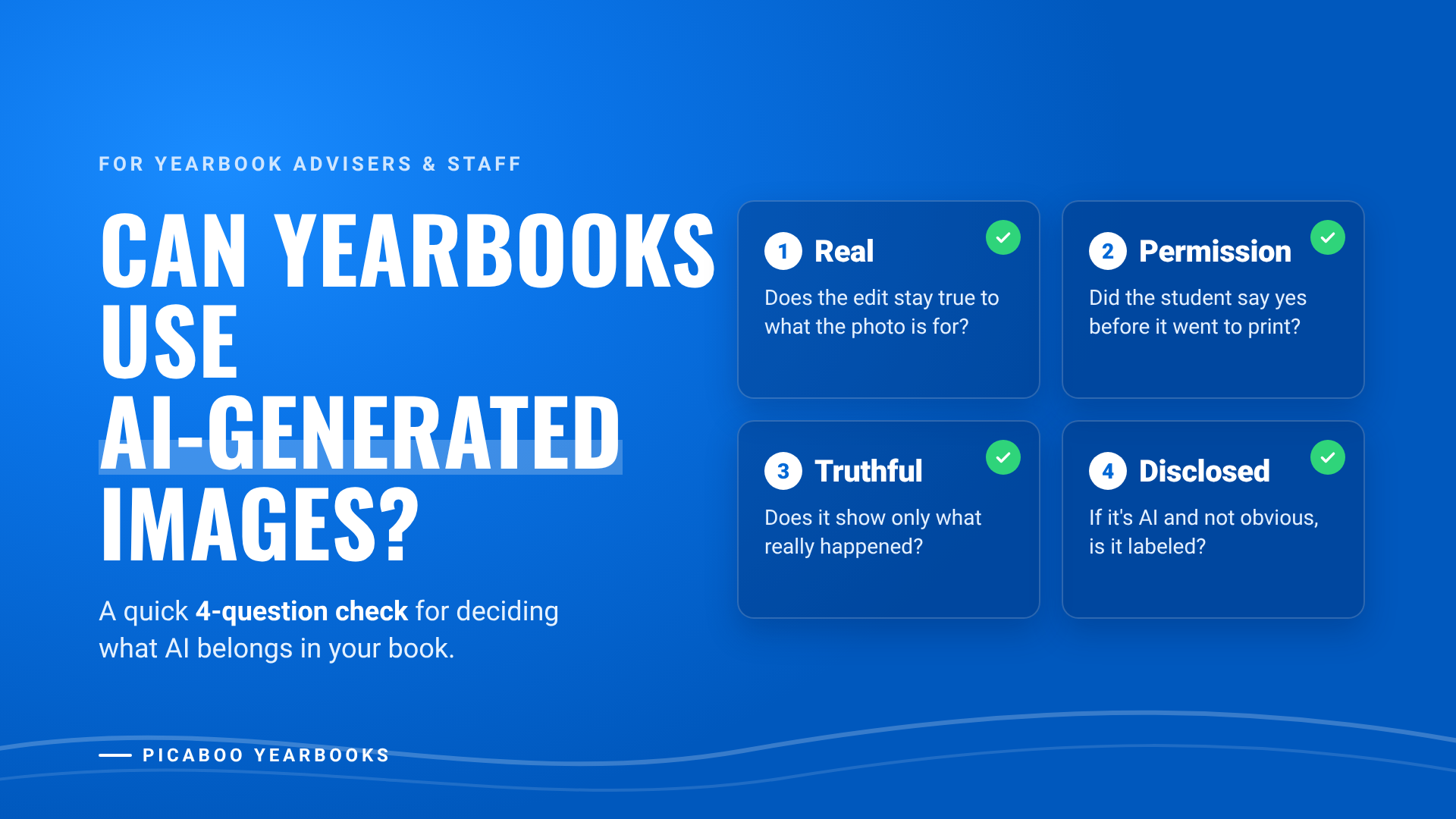
1. Real: Can you edit yearbook photos with AI?
This question is about edits to real photos. Each photo in your book has a job: to show a student as they are, capture what an event looked like, or remember how a season felt. If an edit helps the photo do its job, you're fine. If it changes the job, it doesn't pass.
"It's kind of like art. You know it when you see it," Jo said. "If you take somebody's likeness and adjust it in a way that's not authentic to what the photograph was for, that's where we draw the line."
Passes: removing a background, fixing color or exposure, taking glare off glasses, cleaning up a blemish on a portrait. Plenty of school photographers already use AI for this kind of touch-up.
Doesn't pass: turning a portrait into a cartoon, reshaping a face or body, or making a student look like someone else.
2. Permission: Does a student have to approve AI changes to their photo?
Yes. AI-styled superlatives or fun portrait treatments can be a hit, but only when the students in them said yes first.
"Using AI to create something like superlative pictures can be fun, but you have to get buy-in from the students it involves," Jo said. "Asking permission in a yearbook is far better than asking for forgiveness after it publishes."
If AI will create or change anyone's likeness, get their approval before the page goes in. For students who are minors, follow your district's rules for parent consent.
3. Truthful: Can you use AI art for yearbook themes and designs?
This question is about scenes and events. AI art is fair game for theme illustrations, backgrounds and design elements that don't include real people. The line is anything that shows a person, scene or moment that didn't happen as if it did.
"AI is a new medium, the same way digital art and Photoshop came into the mainstream," Jo said. "There's a place and a method for it. But when it's used to deceive or misrepresent, you know you've crossed a line."
One more thing: AI doesn't get around trademark and copyright rules. A theme built on a branded character or a TV show still needs permission, no matter who (or what) drew it. And the U.S. Copyright Office's current position is that purely AI-generated material can't be copyrighted (U.S. Copyright Office).
4. Disclosed: Do AI images in a yearbook need a label?
Yes, if a reader could reasonably mistake the image for a real photo. A small "AI" badge, a "photo illustration" credit or a note in the colophon all work.
"I think it's inevitable that there will be a standard requirement to annotate images generated with AI, and the extent of that AI," Jo said. "In the meantime, using a badge for AI images that aren't obviously AI is good practice to build into your program now."
There's no national labeling standard for yearbooks yet, but scholastic journalism is moving that way. The JEA National Student Media Contests don't accept photo entries "created using artificial intelligence tools" or that have been "significantly digitally altered" (JEA contest rules). Building a labeling habit into your program now puts your staff ahead of the curve.
A student missed picture day. Can AI fill the gap?
This is where a lot of AI trouble begins. A few students miss the shoot, the deadline is close, and generating their portraits looks like an easy fix. It isn't. A made-up likeness of a student who never agreed to it fails Real, Permission and usually Truthful too.
Try these instead:
Reshoot. Hold a make-up day, or let families send in a photo that meets your specs.
Use a real candid from your event coverage, with the student's OK.
Print "not pictured." It's honest, and it's a yearbook tradition for a reason.
Spot gaps early. If you know who's missing from your coverage in the fall, you have months to fix it before deadline.
Where AI earns its place: helping your staff, not faking students
The best use of AI in a yearbook is giving your staff more time and better ideas, so the book still tells the true story of your year.
On EDONext, Picaboo Yearbooks' design platform, staffs get Ask Ed, a built-in AI assistant that answers questions, suggests design ideas, shows example yearbook pages and offers design tips, along with smart tools that help with layout choices and routine tasks. (AI features are currently available on EDONext, not Creator Studio.)
What we don't offer is any tool that changes a student's face or body.
"We don't offer tools that modify a student's likeness," Jo said. "We don't believe the technology, or the risk of someone's likeness being used in a way they don't want, is worth it for most yearbooks. And honestly, if a staff uses outside software like ChatGPT, that's difficult for us to catch. That's exactly why every program needs its own policy."
What happens to student photos when a yearbook company uses AI?
Advisers and families should ask this question of any yearbook partner. Here's how Picaboo Yearbooks handles it:
We don't sell student information. We never rent or sell students' personal information, and we collect only what's needed to create the yearbook.
Deletion on request. An authorized person at the school can request deletion of a project or its photos in writing, and we delete them within 30 days.
Tagging is per book. When a school turns on photo tagging, the recognition data is used only for that school's book and is deleted after the book is published.
"We never use student photos to train outside AI models."
Read the full details in our Privacy Policy and Terms of Service.
Photo consent forms in the age of AI
Should advisers add AI wording to their school's photo consent forms? Jo's view: not on their own.
"I don't think individual schools should add AI language to their consent forms on their own. It should be handled at the school board level, because different schools will have different standards and expectations across the country," he said. "But it should be discussed and prioritized the next time a district reviews photography consent."
Questions to put on that agenda:
Can AI tools process student photos for tagging or editing, and which vendors are approved?
Can a student's likeness be created or changed with AI in school publications, and who has to approve it?
How long can vendors keep student photos, and how does a family ask for them to be deleted?
Do AI-generated images in school publications need to be labeled?
Free template: what to put in a yearbook AI policy
We turned the four-question check into a one-page Yearbook AI Policy your team can adapt. It covers what's allowed and what isn't, how to handle missing photos, who signs off, and sample wording your school board can consider for its next photo-consent review. It's free for any school, whether or not you create your book with Picaboo.
Get the free Yearbook AI Policy Template →
FAQ
What should a yearbook AI policy cover?
At minimum: which AI uses are OK (organizing, tagging, photo cleanup, theme art), which aren't (changing a real person's likeness without permission, inventing scenes), when to label, what to do about students without photos, and who approves pages before they're submitted.
Can AI create a photo for a student who missed picture day?
We don't recommend it. A generated likeness of a student who didn't agree to it misrepresents them. Reshoot, use a real candid or print "not pictured."
Are AI images allowed in student journalism contests?
The JEA National Student Media Contests don't accept photo entries made with AI tools or significantly altered digitally (JEA contest rules).
Is facial recognition in yearbook software safe?
If your yearbook company uses it, ask three questions: Is it opt-in? Is the data used only for your book? When is it deleted? At Picaboo, tagging is used only for that school's book and deleted after publication, and student photos are not used to train third-party models.
Can you retouch yearbook portraits with AI?
Light cleanup that keeps the portrait true, like removing glare or a blemish, is standard for school photographers. Changing a student's features is not.
"Using AI to help build and organize your book is a great way to spend more time on the fun stuff," Jo said. "But using AI to take shortcuts, or to misrepresent the authenticity and identity of individuals or a school year, is a dangerous path, and it will only get more perilous as AI advances."
Elias Jo is CEO of Picaboo Yearbooks, which helps schools create custom yearbooks with easy online design tools. Flexibility wasn’t always a concept when it came to school yearbooks and we set out to change that. No longer are schools bound by long contracts with confusing prices, minimum orders, and strict deadlines. Request a free sample →